 |
| Claude Montet in his garden, 1921 |
 |
| I think my version of heaven looks a lot like this! |
I am following Nature without being able to grasp her.
I
perhaps owe having become a painter to flowers.
 |
In the Garden, 1895,
Collection E. G. Buehrle, Zürich |
I think without my love of art, I perhaps would not have become a gardener or floral designer in my third life career; following that of a mother and art curator. This summer on my first family trip to Europe, I got to finally visit "the" garden that was the source of inspiration for many of the paintings of the great Impressionist painter Claude Monet. Monet's garden and lily pond at his country house in Giverny, France, has been a continuous source of inspiration to creativity, art research and gardening throughout my life.

Visiting Monet's vibrant gardens and lily pond at Giverny, has been a dreamy personal goal and on my bucket list, since I was a young art history student who could never afford such travel. Experiencing this fantasia of flowers for the first time in June--when blossoms were exploding with color--was simply, wondrous. The garden's vast variety of flowers seemed as etheral in their vitality as the ones that Monet immortalized in his Impressionist paintings.
Located half way between, Rouen and Paris, is the small country town Giverny, where Claude Monet spent 43 years cultivating and composing
this magnificent garden and lily pond that was the subject of the beauty, poetry and prose of his many painting that now hang has in the finest museums
of the world.
I ‘m extremely busy with my garden; it’s such a joy to me
and…I am in raptures at the wonders of nature.

It is well documented that Monet had a deep love and connection to his garden and sought inspiration from its beauty. Monet first rented his pink stucco one-room wide country home in 1883; and finally purchasing it in 1890 with the considerable success of the sales from his paintings of the 1870s that were the hallmark of the revolutionary art movement, known as Impressionism.
The Impressionist artists moved away from realism to a style that tried to capture fleeting and momentary light through short brush strokes side by side. Over the years, Monet transformed his simple country garden typical for the Normand region--with a kitchen garden and an orchard of apple trees-- into a garden with wild vitality like that of his impressionist brushstrokes in one of his landscape paintings. He also added a lily pond that reflected the interest and fashion of Japanese prints that influence many artists of the time. This addition seems to balance the vitality and vibrancy of his more traditional flower garden with the pond's viscus, quite and more contemplative space that is reflective of a deeper more mysterious quality evident in many of Monet's late paintings.


From a gardeners perspective, it just doesn't get much better. In fact, I think this is what my version of heaven may look like; as it is an explosion of color with wild energizing abundance that is simply joyful. Monet was a master gardener carefully composing his garden over many years to reflect the spontenaiety and naturalness just, as he depicted in his plein air paintings-- that we know were carefully planned and usually sketched in nature only to finish the painting in the studio. Every color and variety of flower was composed for contrast and pop like brushstrokes in his paintings. In his garden planning, exploration was encourage by the soft gravel paths and flower arches throughout his garden. I enjoyed too the exotic beauty of his lily pond, but the untamed vitality, abundance of color and variety of his flower garden filled my heart. I think Monet and I are kindered garden spirits as we share the unbridled love of color, wild vitality, and joyful abundance in our garden aesthetics.


After our visit to Monet's country house, garden and lily pond, we toured the small town of Giverny. We ended our visit in the old church yard where Monet was laid to rest. Monet left his country home and garden to his son Michael, who gave it to the French Academy of Arts in 1966, and after 10 years of restoration, it opened to the public in 1980. Giverny was a place of inspiration and solace for Monet, and each season, his garden continues to serve as a vibrant bouquet that continues to inspire and provide joy. It is no wonder why it is one of the most celebrated gardens in the history of art and gardening.


 Tudy’s intimate knowledge of Venice inspired a large part of her life as
historian, landscape designer, and preservationist of this hidden natural world
among the alleyways and canals of this magnificent city built upon water. Exploring these gardens with her really brought
to life the special and unique qualities of Venice both past and present.
Tudy’s intimate knowledge of Venice inspired a large part of her life as
historian, landscape designer, and preservationist of this hidden natural world
among the alleyways and canals of this magnificent city built upon water. Exploring these gardens with her really brought
to life the special and unique qualities of Venice both past and present. 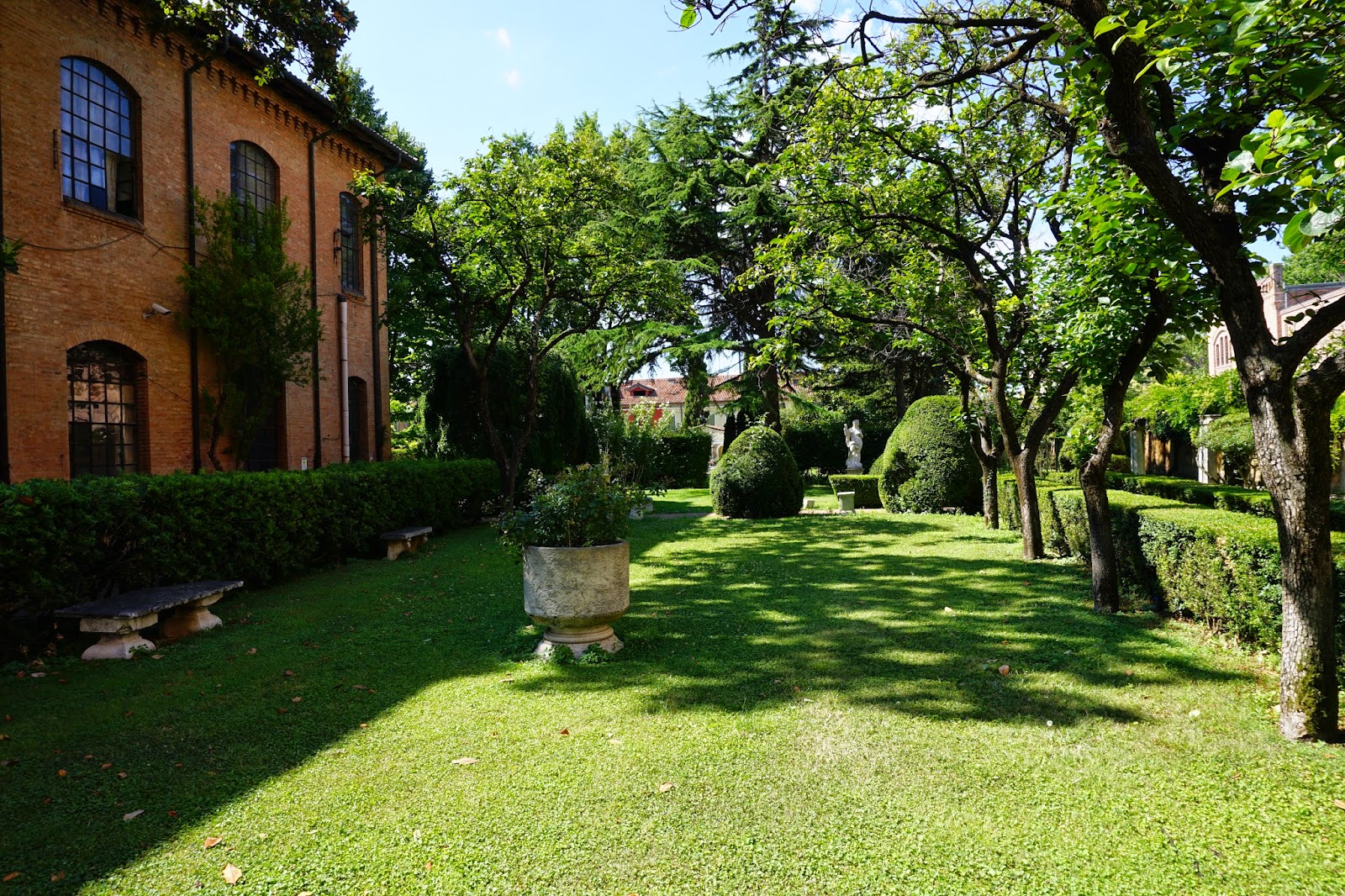


 Fortuny was an innovator of
silk and
velvet fabrics known for impressions of carved relief. Many of his
fabrics
reflect an influence of ancient motifs, Morris prints and botanical
designs. Fortuny lived in Venice during his last years, and here created
an exclusive fabric factory in 1919, which is still in use today. Many of the varieties of plants and flowers in
this master garden inspired some of Fortuny’s most innovative and beautiful
fabric designs.
Fortuny was an innovator of
silk and
velvet fabrics known for impressions of carved relief. Many of his
fabrics
reflect an influence of ancient motifs, Morris prints and botanical
designs. Fortuny lived in Venice during his last years, and here created
an exclusive fabric factory in 1919, which is still in use today. Many of the varieties of plants and flowers in
this master garden inspired some of Fortuny’s most innovative and beautiful
fabric designs. 
 Thanks to the restoration efforts of Tudy, this large historic garden
has been beautifully restored, and still inspires design of the
Fortuny fabrics created today.
Thanks to the restoration efforts of Tudy, this large historic garden
has been beautifully restored, and still inspires design of the
Fortuny fabrics created today.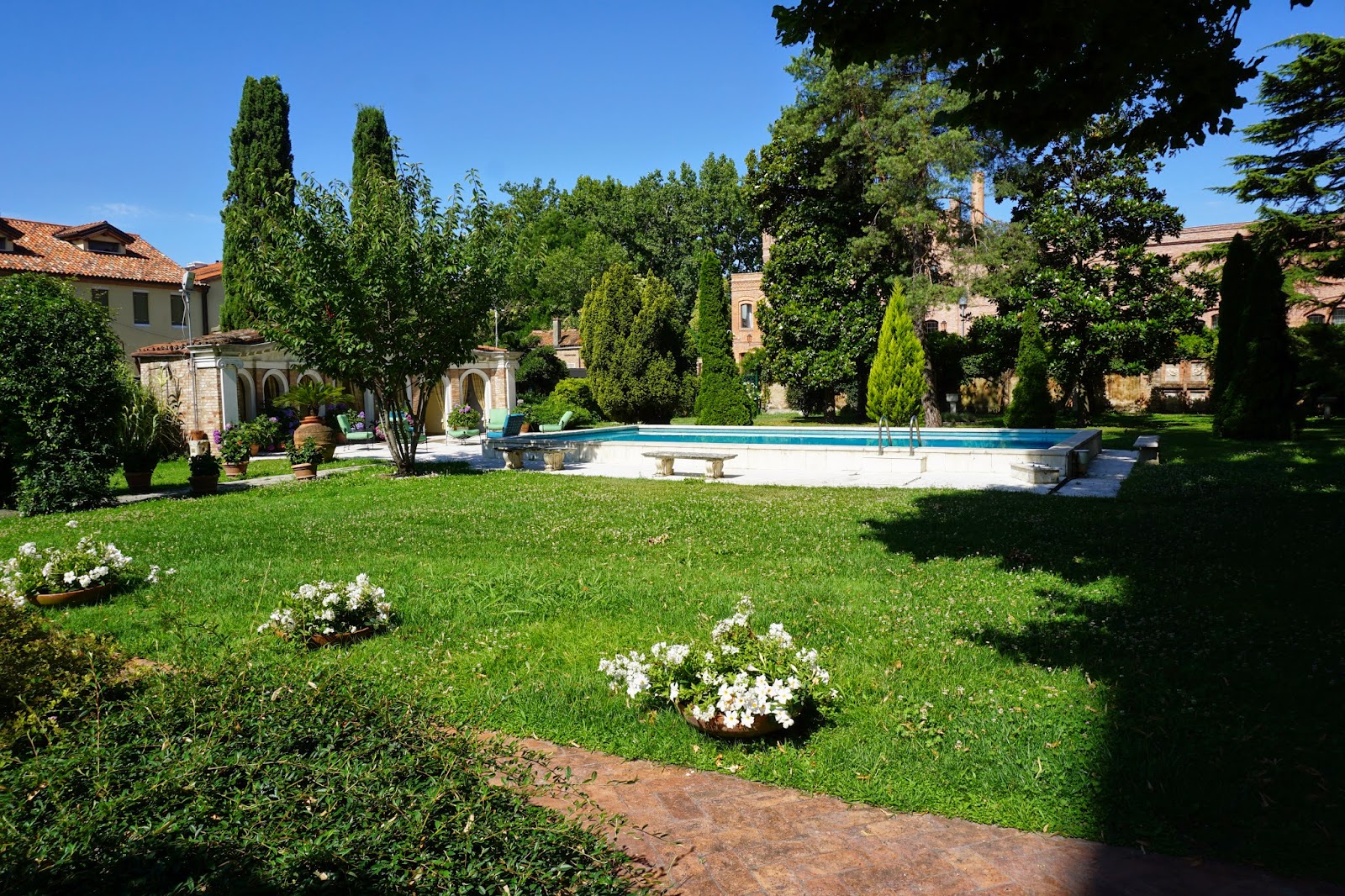 Formal
in its geometry and lined with boxwood, romantic
elements abound in this grand garden; complete with rose covered arbors,
ivy covered brick walls and marble statuary and benches. One would
never guess that such a large parcel was hidden behind the factory's
facade complete with towering magnolias, ornamental pomegranate trees and a large swimming pool anchoring the rear of the garden. The graceful draping wisteria and grape vine covered arbors softened and offered a balance to the hard geometry of the sculpted boxwoods and the brick walls of the factory. After our tour of the garden, we were
invited into
the
exclusive showroom to see the rich and sumptuous fabrics that are still
produced and inspired by this wonderful garden today.
Formal
in its geometry and lined with boxwood, romantic
elements abound in this grand garden; complete with rose covered arbors,
ivy covered brick walls and marble statuary and benches. One would
never guess that such a large parcel was hidden behind the factory's
facade complete with towering magnolias, ornamental pomegranate trees and a large swimming pool anchoring the rear of the garden. The graceful draping wisteria and grape vine covered arbors softened and offered a balance to the hard geometry of the sculpted boxwoods and the brick walls of the factory. After our tour of the garden, we were
invited into
the
exclusive showroom to see the rich and sumptuous fabrics that are still
produced and inspired by this wonderful garden today. 
 Visits to the
factory are not permitted in order to maintain
the secrets of production but the showroom and garden are accessible by
appointment only or with Tudy Sanmartini who has been an official guide
in
Venice since1969. Tudy has become quite a celebrity in luxury travel
articles which feature her many gardens and work. My family and I were
lucky to meet her and over a wonderful lunch with a view of St. Mark
Tower across the water became friends. I look forward to working with
Tudy on a future restoration project in this magnificent city sometime
soon!
Visits to the
factory are not permitted in order to maintain
the secrets of production but the showroom and garden are accessible by
appointment only or with Tudy Sanmartini who has been an official guide
in
Venice since1969. Tudy has become quite a celebrity in luxury travel
articles which feature her many gardens and work. My family and I were
lucky to meet her and over a wonderful lunch with a view of St. Mark
Tower across the water became friends. I look forward to working with
Tudy on a future restoration project in this magnificent city sometime
soon!


